
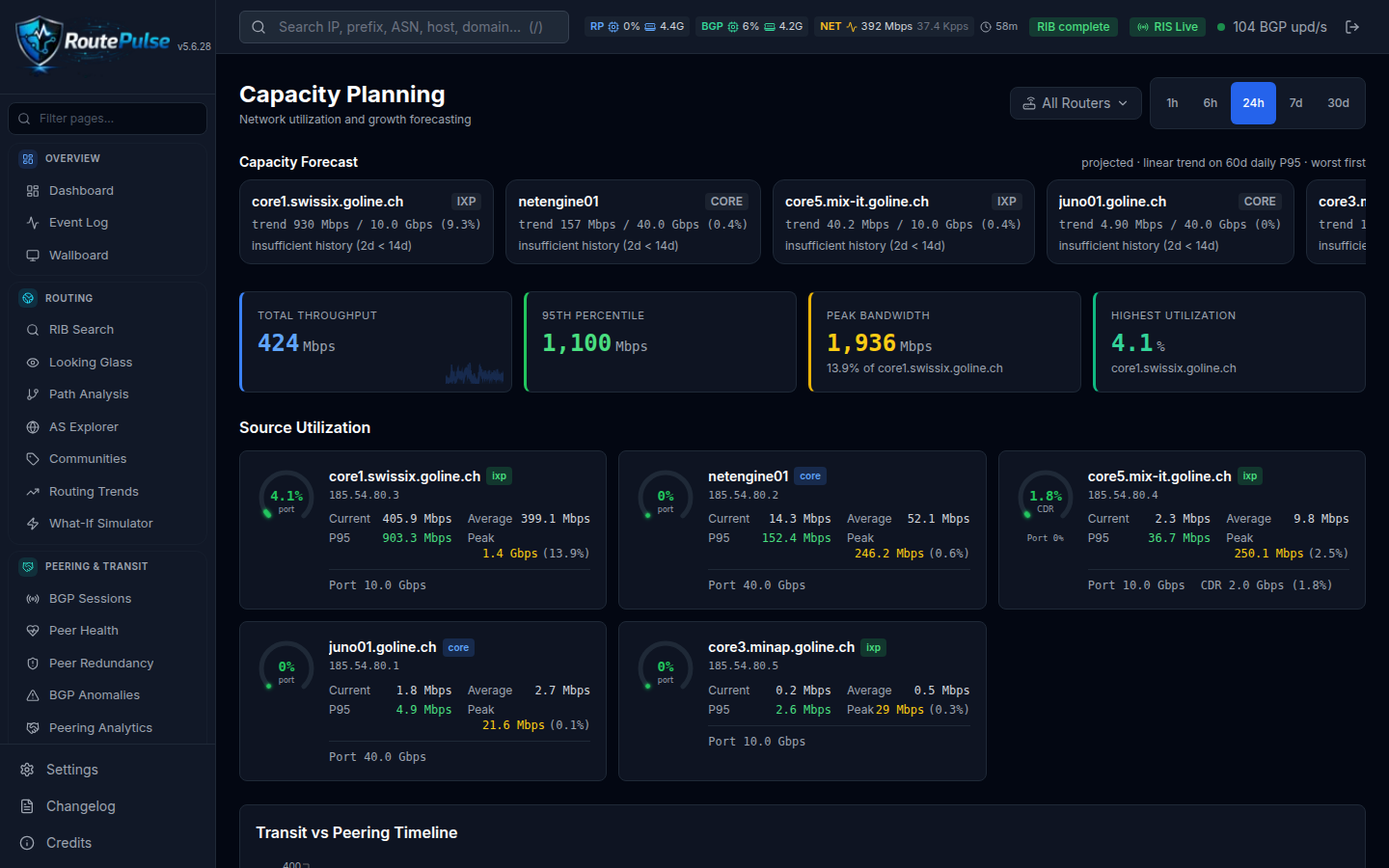
Capacity Planning & Bandwidth Forecasting — ISP-grade P95 with 6-month projection
Capacity Planning answers the only two questions transit procurement actually cares about: “what will my P95 be next quarter?” and “will I exceed my committed data rate before then?”. RoutePulse computes both with the exact methodology your carrier uses to write the invoice — sample every 5 minutes, sort across the billing window, take the 95th-percentile rate per direction, charge on the higher of ingress/egress. The same number that closes your monthly invoice is the number on the dashboard; no approximations, no synthetic counters, no “approximately P95” curves.
The forecast layer runs a 6-month linear regression projection on per-source historical P95 plus a Herfindahl-Hirschman concentration sweep (see Transit Costs). Threshold-band alerts fire when the projected curve crosses the committed data rate (CDR) margin — Telegram + email + WORM audit-chain entry, the same pipeline that drives security incidents. Per-source breakdowns cover Colt, Cogent, Antenna, Lumen, RETN, UPC upstream plus three IXP fabrics (SwissIX, MIX-IT, MINAP), with VPN tunnel throughput polled from FortiGate every 30 s and SD-WAN aggregation across redundant paths. Multi-currency cost modelling (CHF / USD / EUR) makes the what-if analysis usable for international transit contracts without spreadsheet gymnastics.
P95 ISP-grade billing — invoice-accurate
The collector samples each interface every 5 minutes (the standard carrier sampling interval), stores the per-direction rate in capacity_samples_5m, and computes P95 over the billing window via a single ClickHouse quantileExact(0.95) aggregation per source. The dashboard value matches Colt / Cogent / Lumen invoices to the kbps — verified against actual GOLINE billing records during v4.30 rollout. KPI strip surfaces current utilisation, P95 rate, CDR, margin-to-commit, and burst overage live; clicking any tile drills into per-source breakdown.
6-month linear regression projection
Per-source P95 history is fit with ordinary least squares regression in capacity-service.ts; the slope (Mbps/month) is published as a growth rate, the projection is rendered as a dashed continuation of the historical line, and the intersection with the CDR ceiling is computed in closed form. Threshold bands on the timeline visually distinguish normal / warning / critical zones, so the operator sees both the trend and the alert window at a glance.
Per-source breakdown · VPN · SD-WAN · burst overage
Each upstream provider and IXP fabric carries an independent P95 / CDR / overage trio. VPN tunnel throughput is polled from FortiGate every 30 s and stored alongside flow-based capacity samples; SD-WAN traffic is aggregated across redundant paths into a single logical capacity envelope. CDR/port utilisation gauges show committed-bandwidth percentage; burst-overage detection fires the moment P95 crosses the CDR and triggers a Telegram alert with the projected monthly overage cost in the operator’s chosen currency.
Key Capabilities
- ISP-grade P95 billing — 5-minute sampling, per-direction
quantileExact(0.95)in ClickHouse, matches Colt / Cogent / Lumen invoices to the kbps - KPI strip — current utilisation, P95 rate, committed data rate (CDR), margin-to-commit, burst overage; live tile drilldowns to per-source breakdown
- 6-month linear regression projection — OLS fit on per-source P95 history in
capacity-service.ts, closed-form CDR-crossing computation - Threshold-band alerts — Telegram + email + WORM audit-chain entry when projection crosses CDR margin (same pipeline as security incidents)
- Per-source CDR margin — independent P95 / CDR / overage trio for every upstream and IXP fabric (Colt, Cogent, Antenna, Lumen, RETN, UPC, SwissIX, MIX-IT, MINAP)
- Provider efficiency matrix — cost-per-Mbps comparison across transit and peering (cross-link to
/transit-costsfor full HHI concentration analysis) - VPN tunnel throughput — FortiGate 30 s polling, per-tunnel utilisation, stored in ClickHouse alongside flow-based capacity samples
- SD-WAN aggregation — redundant-path traffic consolidated into a single logical capacity envelope per site
- Burst overage detection — alert + projected monthly cost the moment P95 crosses CDR, in CHF / USD / EUR
- Multi-currency cost modelling — CHF / USD / EUR exchange rates pulled daily; what-if scenarios for provider mix changes
- Historical comparison — quarterly P95 deltas highlighted; seasonal patterns visualised on the 6-month timeline
- Export to CSV — full per-source per-month P95 tables for procurement and finance review
Engineered and operated by the GOLINE SOC & Network Engineering team.
Explore all RoutePulse features →