
GoRecruit — AI-assisted recruiting platform by GOLINE SA

GoRecruit
The AI reads the CVs and proposes. Your people decide. The candidate books the interview with one click, in their own language, from a page that stays with them for the whole selection.
See GoRecruit in twelve minutes, in English or Italian
Guided tour of the October 2026 release: the console, the pipeline, the AI, the candidate’s page with the live calendar and the secure section. Candidate data is blurred throughout.
Recruiting software that lives on what your company already has
Most applicant tracking systems charge per seat, keep candidate data in their cloud and still leave the real work to the recruiter: reading, scheduling, chasing, archiving. GoRecruit was built by GOLINE for its own hiring and runs on the systems a company already owns: the shared mailbox, the document management system, the directory, the ticketing tool, the company’s own servers.
Artificial intelligence does the reading: it turns each CV into structured data, compares it with the full job advertisement and ranks the shortlist with a verdict and a written reason. It proposes the invitation, answers routine candidate questions from verified company information, reads replies to proposed dates and writes the interview minutes from the panel’s notes. Every invitation, outcome and offer is a person’s decision, recorded for audit and explained to the candidate on a transparency sheet. Nothing is black-box: the candidate reads what the AI did and who decides.
New in the October 2026 release
Three days of work with the people who use it every day. Everything below is in production at GOLINE.
Progress ring, countdown to the interview, what happens next, contacts, interview ticket with the people the candidate will meet, calendar file, test explained with the real numbers of the questionnaire, how to reach the office by car or train. In four languages.
If no date is fixed yet, the candidate sees every free slot of the next four weeks, refreshed every minute from the real agenda, and books it. The server re-checks availability at the moment of the click; the invitation, the confirmation e-mail and the recruiters’ appointment follow automatically.
Documents, the route from home, withdrawal and deletion open only after a six-digit code sent by e-mail; the verified browser is remembered for a month. Links exist in the database only as a hash, expire after the selection and are never indexed by search engines.
The frequently asked questions on the candidate’s page are the same verified company information the AI uses to answer e-mails: office, parking, hours, interview and test, contract, personal data. Change it once, it changes everywhere.
Every item on the dashboard, proposals waiting for a reply, interviews to confirm, references to contact, opens the candidates’ gallery already filtered on those rows. Reminders and rejections for missing confirmation run on a schedule you set.
No candidate receives a portal link before a recruiter has approved the application: the link travels with the invitation. Accepting a proposed date by e-mail now triggers the confirmation to the candidate as well as to the panel.
Six things a commercial ATS does not do
Built on the document system, the mailbox, the real infrastructure and the IT department the company already has.
The dossier lives in DocuWare
Every CV, e-mail, sheet and document is filed in the company’s document management system with index fields filled by the AI. No parallel archive, no export at the end of the selection.
Real tests, on site
Technical questionnaires generated by the AI on the company’s real infrastructure, anonymised, with interactive labs: network map, firewall policy, terminal, packet capture, code and configuration. Corrected automatically into a skills matrix.
A calendar that works by itself
Free slots proposed with one click, a live calendar on the candidate’s page, confirmations, cancellations and alternative dates read by the AI, appointments in the recruiters’ calendar, reminders before a rejection for no reply.
Transparency built in
The candidate reads what the AI did, who decides and what they can ask: human review, main factors, correction and deletion. A monthly register of decisions and a fairness check keep the process auditable (nLPD, AI Act).
A living talent pool
Good profiles that were not chosen stay in the matching of new positions, with the candidate’s consent and an expiry date; CV refresh from the page, deletion when the time is up.
Onboarding and alerts where they matter
When a candidate is hired: checklist with deadlines from the first day and a ticket to the IT department in one click. A Telegram message for every new candidate, with the facts that count, to the people who follow the selection.
The pipeline, in six steps
Every fifteen minutes GoRecruit makes a full round. Everything that happens ends up in the candidate’s dossier, in DocuWare and in the register of decisions.
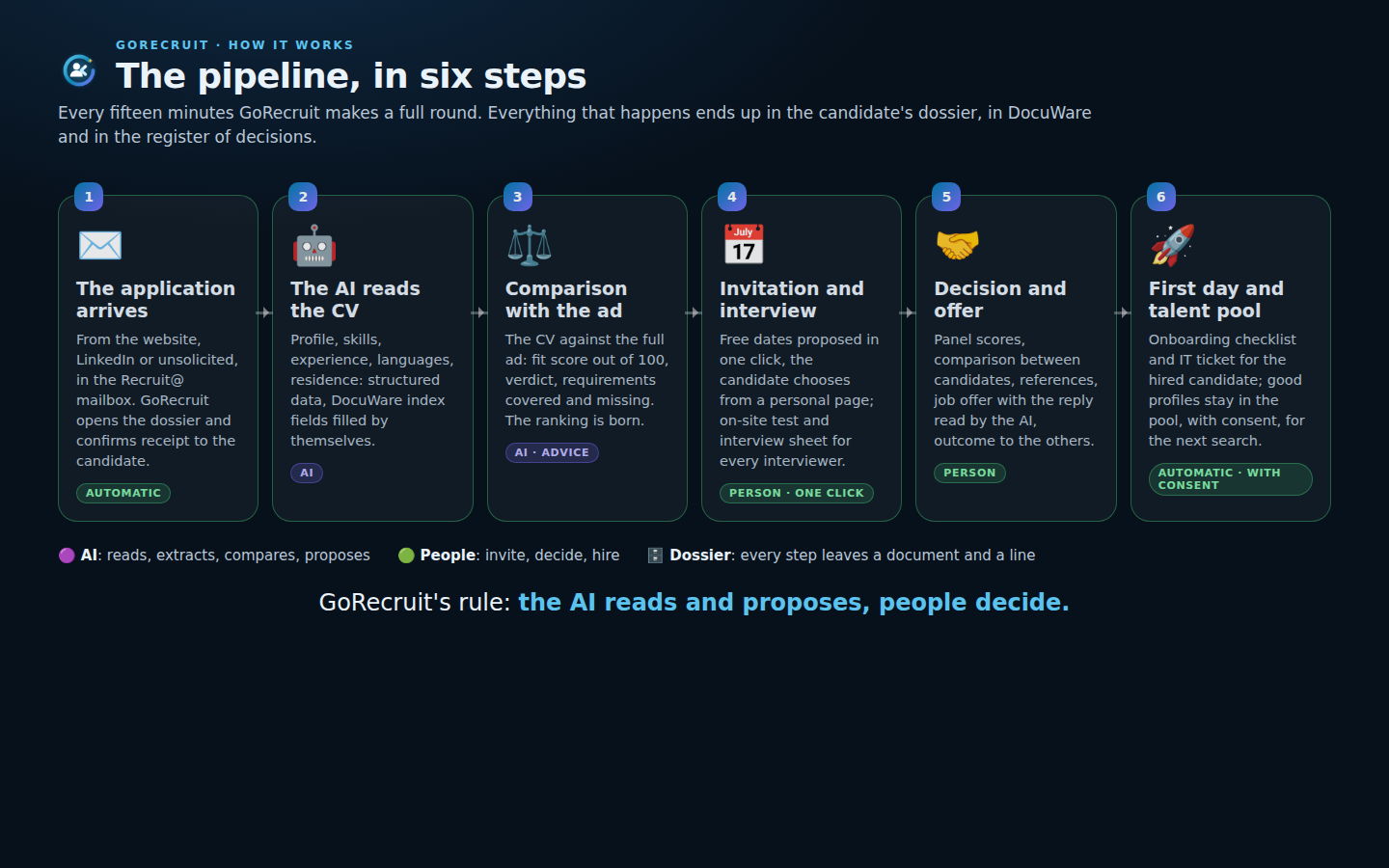
Purple is the AI: it reads, extracts, compares and proposes. Green is the people: they invite, decide and hire. Each step leaves a document in the dossier and a line in the register, so that any decision can be explained months later.
The application arrives
From the website form, LinkedIn or a spontaneous e-mail, into the shared mailbox. GoRecruit opens the dossier and confirms receipt in the candidate’s language.
automaticThe AI reads the CV
Profile, skills, experience, languages, residence: structured data with a fixed schema; DocuWare index fields filled automatically.
AIMatch with the job ad
The CV against the full advertisement: fit score out of 100, verdict, requirements met, partial and missing, written reason. The shortlist is born.
AIInterview
The recruiter approves the invitation; the candidate books a free slot from the live calendar on a personal page; on-site test and an interview sheet for every interviewer.
peopleDecision and offer
Panel scores, side-by-side comparison, references, job offer with the reply read by the AI, outcome to the others.
peopleFirst day and talent pool
Onboarding checklist and IT ticket for the hired candidate; good profiles stay in the pool, with consent, for the next position.
peopleHow the AI works: two readings of the CV, fixed rules, an explained result
Claude models by Anthropic, chosen per task: a fast reader for extraction, the most capable model for the assessment. Every answer has a fixed schema. No free text to interpret, no decision taken by the model.
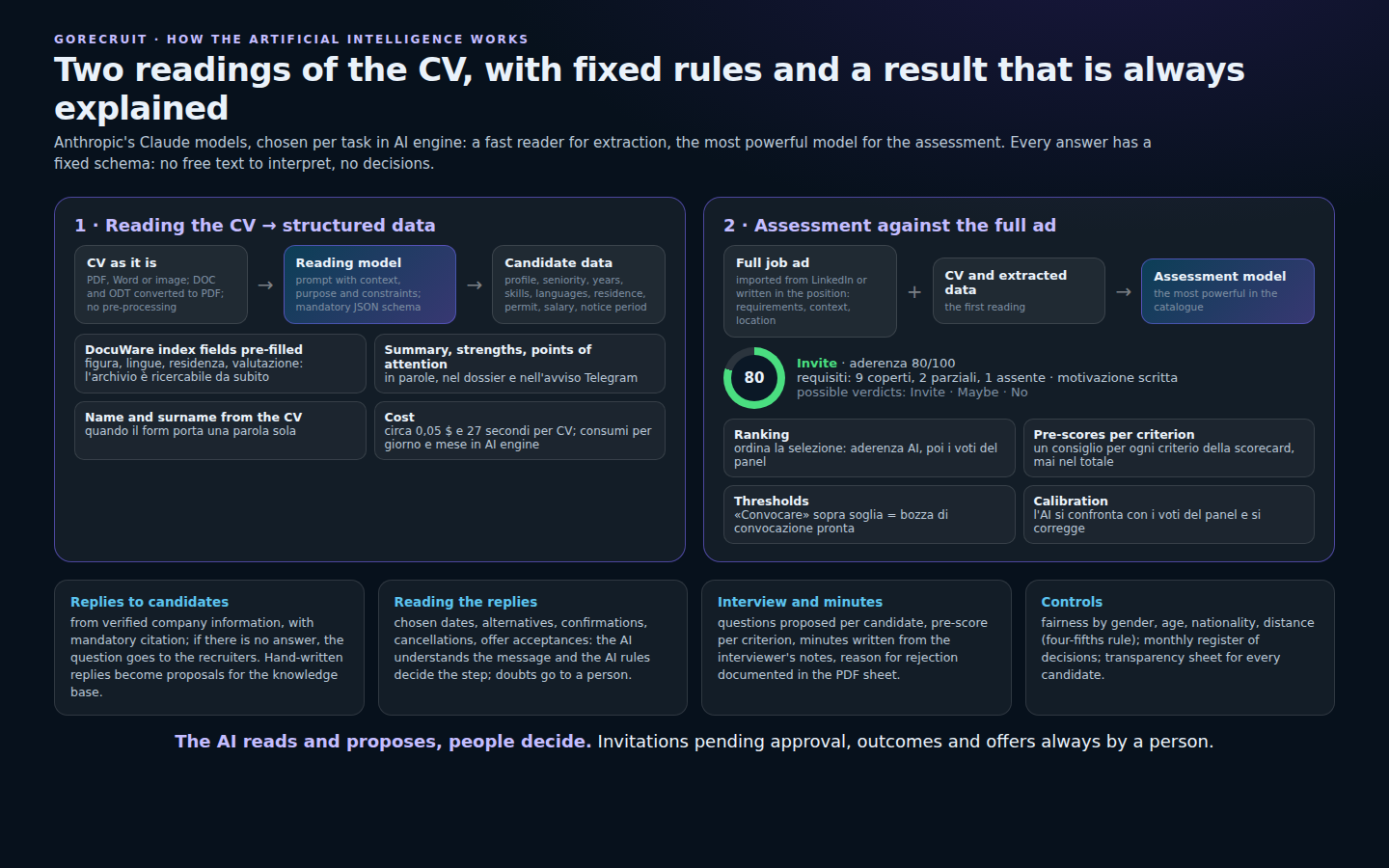
Reading: CV to structured data
The document as it is (PDF, Word, image) becomes profile, seniority, years, skills, languages, residence, expected salary; summary, strengths and points of attention. About five cents and thirty seconds per CV.Assessment against the full job ad
Fit score out of 100, verdict (Invite · Discuss · No), requirements met, partial and missing, with the written reason. It orders the shortlist and prepares the draft invitation; it does not decide.Around the interview
Answers to candidate questions from verified company information, with mandatory citation; replies to proposed dates read and acted on; interview questions proposed; minutes written from the panel’s notes.Under control
Fairness check (four-fifths rule), monthly register of decisions, transparency sheet for every candidate, cost and usage per task and per model.The candidate’s side: a page that stays with them
A personal page from the link in the invitation, no login, in the candidate’s language. What is public stays simple; what is personal opens with a code.
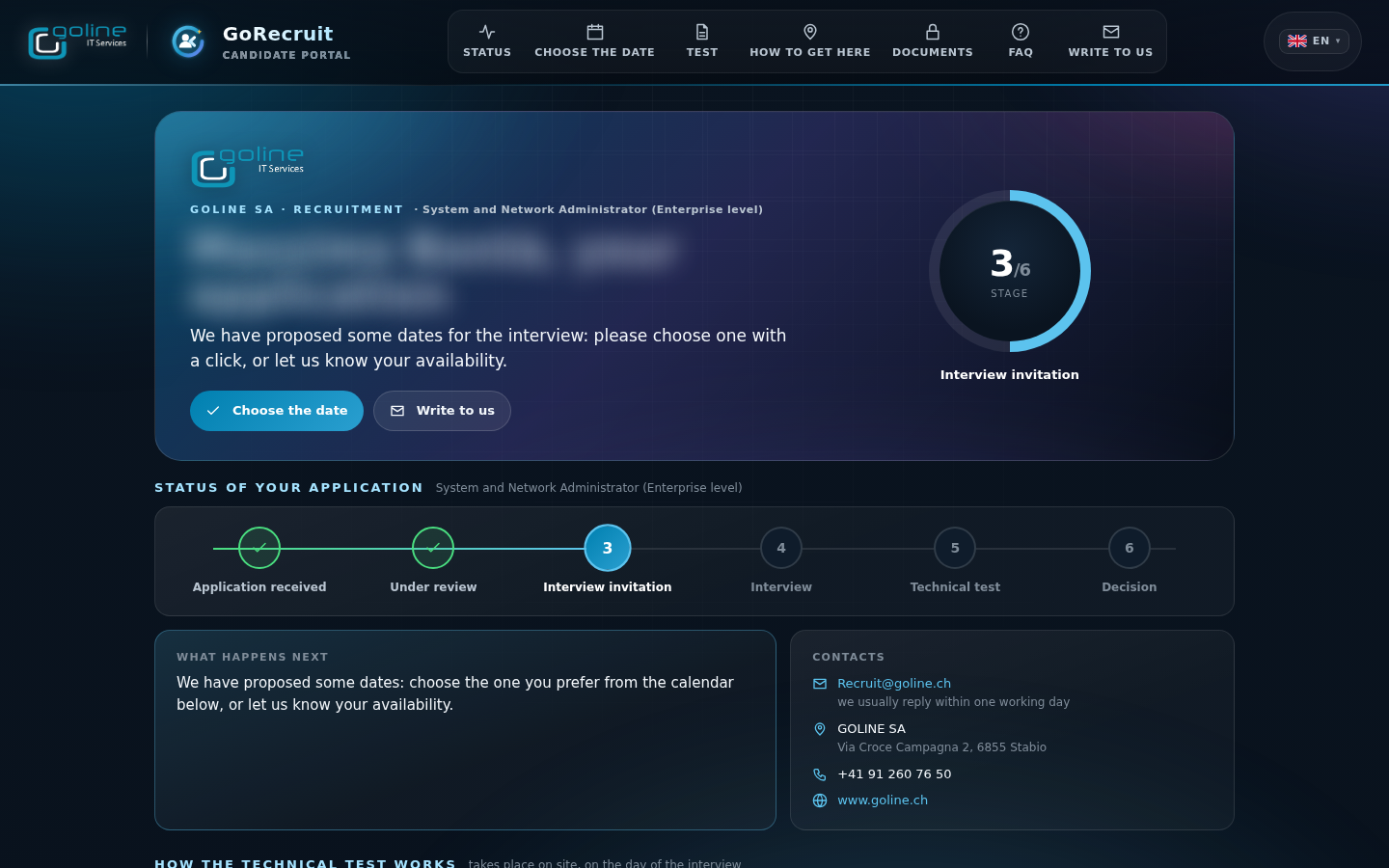
Where the application stands
Progress ring, stages, what happens next, contacts. Countdown to the interview, calendar file, the people they will meet.Interview booked in one click
Live calendar of free slots, refreshed every minute; dates as buttons in the e-mail; confirmation of attendance; move or cancel with a message.Prepared for the day
How the technical test works, with the real number of questions, areas and labs; how to reach the office by car, by train, where to park; frequently asked questions from verified company information.Secure section
Documents, the route from home, CV update, withdrawal and deletion request open after a six-digit code sent by e-mail; the browser stays verified for a month.Transparency, consent, four languages
What the AI did and who decides; yes or no to the talent pool; Italian, German, English and French, detected from the application and switchable on the page.Security and privacy by design
A candidate’s link travels by e-mail, gets forwarded and lands in shared calendars. GoRecruit assumes it will, and protects what matters anyway.
One-time code
Sensitive data opens only after a six-digit code sent to the candidate’s mailbox, valid ten minutes, five attempts, three codes an hour. No password to remember, nothing to reset.
Hashed links
Every link exists in the database only as a hash, like a password; a new one per e-mail, all revocable from the dossier, expiring after the selection.
Invisible to robots
Search engines, link previews and mail scanners get a page with no data; every page is marked not to be indexed, so no candidate link can ever appear in a search result.
Hardened edge
Public pages served by a separate unprivileged process behind a firewall VIP with IPS, web application firewall, rate limits and a daily check; every external call logged with country and reputation.
The recruiter’s console
One place for the whole selection. Screenshots from production with candidate data blurred.

Dashboard
Today’s numbers, open positions, next interviews, to-do items that open the filtered view, onboarding in progress, pipeline status.

Shortlist
Fit score, verdict and panel total per application; invite, compare two or three candidates, open the dossier.

Dossier and scorecard
AI analysis, panel scores per criterion, documents in DocuWare, correspondence, dates, portal links and verified browsers, skills matrix, references, decision.

Position sheet
The job ad as the AI reads it, the three-month calendar, who follows the selection, templates, AI-prepared invitations waiting for a click, similar profiles in the archive.

Transparency sheet
What the AI did, with date and model; which automatic actions fired; which people assessed or decided; the text the candidate reads.

DocuWare archive
Every dossier, read-only from the document system: search in index fields and inside the CVs, filters, numbers by profile and outcome.

Statistics
Funnel, pace, pool, correlations between AI reading, assessment, test and panel, automation, AI costs, calendar, sources.

Questionnaires and labs
Generated by the AI on the real infrastructure, anonymised; one-time links, automatic correction, skills matrix.

E-mail templates
Placeholders, Outlook-safe preview, variants in German, English and French translated by the AI, test send.

Onboarding
Checklist with deadlines from the first day, accounts, laptop, access, badge, welcome; IT ticket in one click.

Secure section
The candidate’s documents and route open after a one-time code sent by e-mail; the browser stays verified for a month.

Route, documents, FAQ
Driving directions from home, documents in the viewer, CV update, withdrawal, deletion request, frequently asked questions.
Trust and compliance
Candidate data is personal data. GoRecruit is built so that the rules are kept by design, not by memory.
People decide
No decision is taken by the AI alone: invitations, outcomes and offers are approved by a person and recorded with their name.
Register of decisions
Every automatic action, AI assessment and human decision is logged; a monthly register is produced for audit (nLPD, AI Act).
Fairness check
Verdicts compared across gender, age, distance and language with the four-fifths rule; anomalies surfaced to the people who decide.
Your servers, your data
Runs on the company’s infrastructure; candidate data stays in DocuWare and in the company database; consent and retention declared to the candidate.
Hiring with your own systems and your own rules
GoRecruit is operated by GOLINE for its own selection process and can be delivered to companies that want the same: AI that reads, people that decide, documents where they belong, candidates treated as people.
Talk to GOLINE